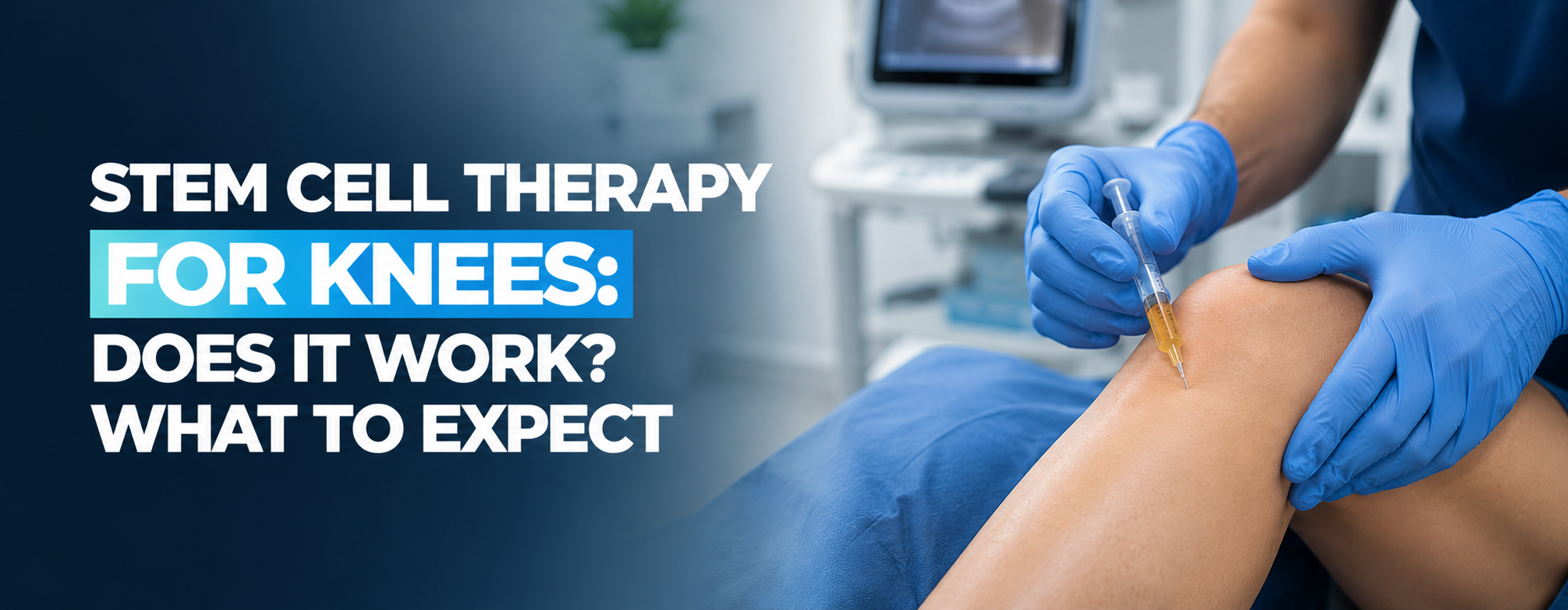
Stem cell procedures for knees have become one of the most searched regenerative treatments in the country — and the reason is straightforward. Knee pain is among the most common reasons adults see a doctor, and the conventional options haven’t changed much in decades: painkillers, cortisone shots, physical therapy, and eventually knee replacement surgery. For millions of patients, stem cell therapy represents something genuinely different: a way to address the underlying damage, not just manage the symptoms.
This article explains what stem cell injections for the knee actually do, which conditions respond best, how the procedure works, and what separates a realistic result from an overpromise.
What Stem Cell Injections Do Inside the Knee Joint
The knee is one of the most mechanically demanding joints in the body. It absorbs impact, rotates, bends, and carries load — all while relying on cartilage that has almost no ability to repair itself. Cartilage has very poor blood supply, which means when it breaks down, the body can’t efficiently deliver the repair cells it needs to that site. That’s why knee arthritis and cartilage damage tend to worsen over time rather than resolve on their own.
Stem cell shots in the knee work by bypassing that limitation. When a concentrated solution of your own stem cells gets injected directly into the joint, two things happen. First, the stem cells begin receiving chemical signals from the damaged tissue and can develop into the cell types the joint needs — cartilage cells, connective tissue cells, or synovial tissue. Second, and often more immediately impactful, the stem cells release anti-inflammatory cytokines and growth factors that reduce the chronic inflammation driving the pain. This signaling effect — called the paracrine effect — is responsible for much of the early pain relief patients experience.
Over time, as the regenerative process continues, the structural repair can improve joint function and slow the progression of degeneration.
Which Knee Conditions Respond Best
Stem cell knee injections are not a universal fix. The conditions that respond most predictably are those involving cartilage degeneration, joint inflammation, and soft tissue damage — where there is still enough viable tissue for the stem cells to work with.
Knee Osteoarthritis
Knee arthritis is the primary indication for stem cell therapy. In osteoarthritis, the cartilage lining the joint surfaces wears down progressively, causing bone-on-bone friction, inflammation, and pain. Stem cell injections have shown consistent results in reducing pain, improving function, and in some cases slowing cartilage loss in mild to moderate osteoarthritis. Severe bone-on-bone cases with minimal remaining cartilage respond less predictably — though many patients still experience meaningful pain reduction even when full cartilage regeneration isn’t achievable.
Meniscus Tears
Meniscus tears are one of the most common knee injuries, and surgical outcomes are inconsistent — particularly for degenerative tears in older patients. Stem cell therapy can promote healing of partial tears and reduce the inflammation that makes these injuries chronically painful. It’s particularly useful for patients who have been told surgery is their only option but want to exhaust non-surgical approaches first.
Ligament and Tendon Injuries
Partial ligament tears, chronic tendinopathy around the knee, and soft tissue injuries that haven’t healed with physical therapy all respond to stem cell treatment. When combined with PRP therapy, results are often stronger — PRP amplifies the healing signal while stem cells contribute to structural repair.
Post-Surgical Knee Pain
Patients who had knee surgery — arthroscopy, meniscus repair, or even partial knee replacement — and still experience chronic pain are often good candidates. Residual inflammation, scar tissue, and ongoing cartilage degeneration after surgery can all be addressed by stem cell injections when conservative treatments have failed to resolve the problem.
Stem Cell Therapy vs. Knee Replacement: The Real Comparison
This is the question most patients are really asking when they search for stem cell procedures for knees. Total knee replacement (TKR) is one of the most common surgeries in the US, with over 700,000 performed annually. It works well for many patients, but it comes with real tradeoffs: general anesthesia, a recovery measured in months, a mechanical implant that has a lifespan, and the possibility of ongoing pain even after surgery.
Stem cell therapy isn’t a guaranteed alternative for everyone. For patients with end-stage knee arthritis where virtually all cartilage is gone, stem cells don’t have enough viable tissue to regenerate and replacement surgery may genuinely be the better path. But for a significant number of patients — particularly those with moderate arthritis, meniscus damage, or post-surgical pain — stem cell injections can delay or eliminate the need for surgery entirely.
The key difference is what each intervention does. Knee replacement removes and replaces the damaged joint with a mechanical implant. Stem cell therapy attempts to repair the biological joint. When it works, it preserves the natural joint, avoids the risks of major surgery, and allows faster return to activity. When the damage is too advanced, even well-executed stem cell therapy may provide pain relief without sufficient structural repair to avoid surgery long-term.
An honest evaluation — including review of your imaging and full clinical history — is the only way to determine which category you fall into. At our practice, we don’t recommend stem cell therapy when surgery is the medically appropriate answer. We also don’t default to surgery when stem cell therapy is a viable option.
How the Procedure Works
The procedure takes place in a single visit and involves two phases: harvest and injection.
In the harvest phase, stem cells are collected from your own body — either from bone marrow (drawn from the hip) or from adipose (fat) tissue. Both are done under local anesthesia. The collected sample goes into a centrifuge to concentrate the stem cells and prepare them for injection. Adipose tissue yields significantly higher stem cell concentrations and tends to be a less uncomfortable harvest; bone marrow has the longer clinical track record in orthopedic applications. Our physicians evaluate which source is more appropriate based on your specific condition.
In the injection phase, the concentrated stem cell solution gets delivered directly into the knee joint under ultrasound or fluoroscopic guidance. Imaging guidance is not optional — it determines placement accuracy, and placement accuracy determines outcomes. The entire procedure takes two to three hours from start to finish.
After the procedure, expect soreness at both the harvest site and the injection site for several days. Most patients return to light daily activities within two to three days. Avoid NSAIDs for at least two weeks — they suppress the inflammatory response that stem cell therapy intentionally triggers. High-impact activity should wait four to six weeks.
What Results Look Like and When
Stem cell therapy works slowly compared to cortisone shots. Don’t expect significant relief in the first two weeks. The regenerative process takes time — most patients notice meaningful improvement between four and twelve weeks after treatment. Results continue developing over six to twelve months as tissue repair progresses.
Studies on stem cell injections for knee osteoarthritis consistently report reduced pain scores and improved function over 12 to 24-month follow-up periods. Cartilage volume improvements have been documented on MRI in some trials, though results vary by case severity.
Duration of relief typically ranges from one to three years from a single treatment. Some patients maintain results longer, particularly when the underlying condition is less advanced. A second treatment may be needed for more severe cases or if symptoms gradually return. Combining stem cells with PRP in the same treatment plan often produces stronger and more durable outcomes.
Pros and Cons of Stem Cell Therapy for Knees
Being direct about tradeoffs is part of how we practice. Here’s an honest breakdown.
The advantages: no surgery, no general anesthesia, no mechanical implant with a lifespan. Recovery is measured in days to weeks, not months. Because the procedure uses your own cells, there’s no rejection risk and no foreign material introduced into the joint. For conditions that respond well, results can be durable and may eliminate the need for surgery altogether.
The limitations: results aren’t guaranteed, and outcomes vary based on age, severity of damage, and individual healing response. It works more slowly than a steroid injection. Most insurance plans won’t cover it. Advanced bone-on-bone arthritis with minimal remaining cartilage is unlikely to produce enough structural repair to avoid surgery long-term, even if pain improves. And finding a provider who uses appropriate imaging guidance and proper technique matters significantly — the quality of the procedure affects the outcome.
Stem Cell Knee Injections in Orlando
If you’re in the Orlando or Lake Nona area dealing with knee pain from arthritis, a meniscus tear, or an injury that hasn’t resolved, and you want to understand whether stem cell therapy is a realistic option for your specific case, contact our team to schedule a consultation.
At Regenerative Sport, Spine & Spa, Dr. Manuel Colón and Dr. Dana Kleinman review your imaging, evaluate your history, and give you a direct assessment of whether stem cell therapy is appropriate — or whether a different approach makes more clinical sense. Bring your most recent MRI or X-ray if you have one.
You can also explore related topics: see how stem cell therapy works for back pain, compare PRP vs stem cells for your condition, learn about knee pain treatment options at our practice, or read our detailed breakdown of bone marrow vs adipose stem cells.
Frequently Asked Questions
Does stem cell therapy work for knees?
For mild to moderate knee osteoarthritis, meniscus tears, ligament injuries, and post-surgical pain, yes — clinical evidence consistently shows reduced pain and improved function. Multiple studies report significant improvements in pain scores and joint function over 12 to 24 months. Results are less predictable for severe bone-on-bone arthritis where minimal cartilage remains. The right candidate selection is what determines whether a patient benefits, which is why an evaluation with imaging is the necessary starting point.
How long does stem cell therapy last for knees?
Most patients experience meaningful relief for one to three years from a single treatment. Because stem cell therapy addresses the underlying tissue damage rather than just suppressing symptoms, results tend to be more durable than steroid injections. Some patients maintain benefits longer, particularly when the condition is less advanced. A second treatment may be needed over time. Combining stem cells with PRP often extends and strengthens results.
How much does stem cell therapy for knees cost?
Stem cell procedures for knees typically cost between $3,000 and $10,000 depending on the stem cell source, the number of injection sites, and whether PRP is combined in the same treatment. Adipose procedures and bone marrow procedures are priced differently based on the complexity of the harvest. Most insurance plans classify stem cell therapy for knees as investigational and don’t cover it. Workers’ compensation and some auto insurance claims do provide coverage depending on the case. HSA and FSA funds can often be used. Ask about specific pricing and payment options during your consultation.
Can stem cell therapy replace knee replacement surgery?
For some patients, yes. Patients with mild to moderate arthritis, meniscus damage, or persistent pain after prior knee procedures are often able to avoid or significantly delay knee replacement with stem cell therapy. For patients with end-stage arthritis where virtually all cartilage is gone, stem cells may reduce pain but are unlikely to eliminate the need for replacement long-term. The only accurate way to determine which category you’re in is an evaluation with current imaging. We don’t recommend stem cell therapy when knee replacement is the medically appropriate answer.
Does Medicare or insurance cover stem cell therapy for knees?
Medicare does not currently cover stem cell therapy for knee conditions, and most private insurance plans deny coverage by classifying it as investigational. Workers’ compensation and auto insurance cases are exceptions — coverage depends on the specific policy and claim details. HSA and FSA funds typically can be applied. Many practices offer financing options. Always ask your provider directly about coverage pathways before assuming full out-of-pocket cost.
What are the pros and cons of stem cell therapy for knees?
The main advantages are no surgery, no general anesthesia, no mechanical implant, rapid recovery, and no rejection risk since the procedure uses your own cells. For conditions that respond well, results can last years and eliminate the need for surgery. The limitations are that results vary by patient and condition severity, the procedure works more slowly than steroids, most insurance won’t cover it, and severely degenerated joints are less likely to achieve full structural repair. Quality of the procedure — specifically imaging guidance and proper technique — also significantly affects outcomes.