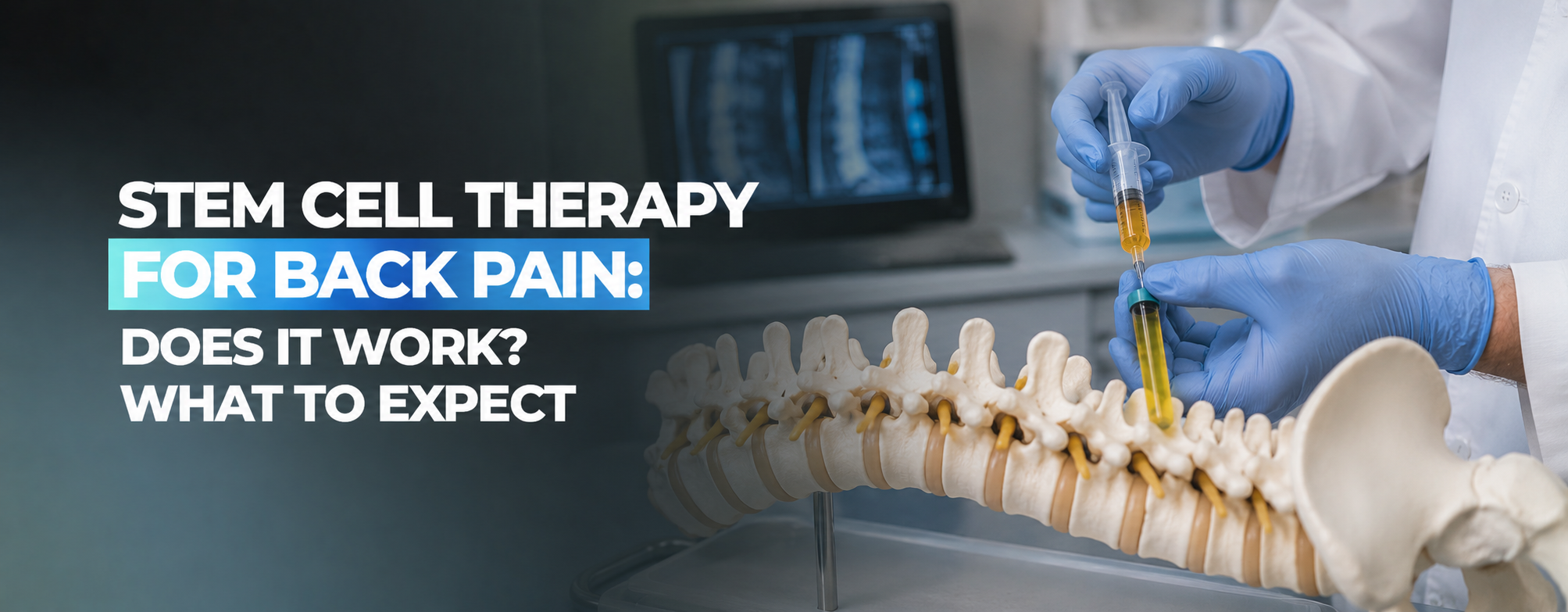
Stem cell therapy for back pain has moved from experimental fringe to a legitimate treatment option that thousands of patients consider every year. The data backs it up: search volume for this topic has grown significantly as more people look for alternatives to surgery and steroid injections that wear off. But with that growth comes confusion — about what stem cells actually do, which conditions respond, and what separates a qualified provider from a clinic making promises the science doesn’t support.
This article gives you a clear, honest picture of what stem cell injections for back pain can and can’t do, based on current clinical evidence and the conditions we treat at our practice in Orlando.
How Stem Cells Work on Back Pain
Stem cells are undifferentiated cells — meaning they haven’t committed to becoming a specific tissue type yet. When introduced to a damaged environment, they respond to chemical signals from surrounding cells and can develop into the type of tissue the body needs at that site. For back pain, that means they can potentially become disc cells, cartilage cells, or connective tissue cells depending on where they’re placed and what damage exists.
Beyond differentiation, stem cells do something equally important: they release signaling molecules called cytokines and growth factors that reduce inflammation and activate the body’s own local repair mechanisms. This paracrine effect — where the stem cells communicate with surrounding damaged cells — is often responsible for the pain relief patients experience, even before significant tissue regeneration occurs.
For the spine specifically, this matters because intervertebral discs have almost no blood supply. Damaged disc tissue can’t recruit repair cells through the bloodstream the way a muscle injury can. A direct injection of stem cells bypasses that limitation and delivers regenerative signals exactly where the damage is.
Which Types of Back Pain Respond to Stem Cell Injections
Stem cell therapy is not a blanket solution for all back pain. The conditions where it shows the strongest clinical results are those involving degeneration or structural damage to soft tissue, joints, and discs.
Degenerative Disc Disease
This is the primary indication. When the discs between vertebrae lose height, hydration, and structural integrity, they cause chronic pain and nerve irritation. Stem cells introduced into the disc space have shown the ability to slow or partially reverse this degeneration — improving disc hydration and height in imaging studies, and reducing pain scores in clinical trials. It works best when degeneration is mild to moderate. Severely degenerated discs with minimal remaining viable cells respond less predictably.
Facet Joint Arthropathy
The small joints along the back of the vertebrae degenerate with age and wear, causing localized and referred back pain. Stem cell injections into facet joints can reduce inflammation and support cartilage repair, offering more durable relief than repeated steroid injections that carry cumulative risk.
Sacroiliac Joint Dysfunction
SI joint pain is one of the most underdiagnosed causes of lower back pain. It often gets attributed to disc problems or sciatica when the actual source is the joint connecting the spine to the pelvis. Stem cell therapy for lower back and joint pain at the SI joint has shown positive outcomes in patients who have exhausted conservative options.
Post-Surgical Back Pain
Patients who had spine surgery but still experience chronic pain — sometimes called “failed back surgery syndrome” — are often good candidates. Scar tissue, residual inflammation, and ongoing disc degeneration can all contribute to post-surgical pain that stem cells can address at the tissue level.
Chronic Ligament and Soft Tissue Injuries
Ligament laxity and chronic soft tissue injuries around the lumbar spine that haven’t healed with physical therapy or rest also respond to stem cell therapy, particularly when combined with PRP therapy to amplify the healing signal.
Bone Marrow vs. Adipose Stem Cells for Back Pain
Two sources dominate clinical practice: bone marrow aspirate concentrate (BMAC) and adipose (fat)-derived stem cells. Both use your own tissue, which eliminates rejection risk. The choice matters because they have different characteristics.
Bone marrow stem cells have the longest clinical track record. They’ve been studied extensively in orthopedic and spinal applications, and the research base is more established. The procedure involves drawing marrow from the hip — less invasive than it sounds, but it does require a separate harvest site.
Adipose-derived stem cells come from a small fat sample, typically taken from the abdomen or flank under local anesthetic. Fat tissue contains a significantly higher concentration of mesenchymal stem cells than bone marrow — some studies report up to 1,000 times more. The harvest is less painful and concentration stays consistent regardless of age, whereas bone marrow stem cell counts decline with age.
At our practice, Dr. Colón and Dr. Kleinman evaluate which source is appropriate based on your specific condition, age, and treatment goals. For spinal conditions, both are viable — the best choice depends on factors that only a clinical evaluation can determine. You can also read our detailed comparison of bone marrow vs. adipose stem cells for a deeper breakdown.
What the Procedure Actually Involves
The procedure has two main phases: harvest and injection. Both happen on the same day in most cases, and the total time from start to finish is typically two to three hours.
In the harvest phase, a small amount of bone marrow or fat tissue is collected under local anesthesia. The sample goes into a centrifuge to concentrate the stem cells and remove unnecessary components. The result is a highly concentrated solution of your own regenerative cells.
In the injection phase, the concentrated stem cells are delivered directly into the target area — the damaged disc, the affected facet joints, or the SI joint — using fluoroscopic or ultrasound guidance. Imaging guidance is not optional here. Precise placement determines outcomes. A clinic that performs these injections without real-time imaging should not be performing them at all.
Post-procedure, expect soreness at both the harvest site and the injection site for several days. Most patients return to light activity within two to three days. Avoid NSAIDs for at least two weeks after treatment, as they suppress the inflammatory response that stem cell therapy intentionally activates. Strenuous activity and heavy lifting should wait four to six weeks.
What Results Look Like and When to Expect Them
Stem cell therapy works more slowly than steroid injections. Don’t expect dramatic relief in the first two weeks. The biological process of tissue repair and inflammation reduction takes time — most patients begin noticing meaningful improvement between four and twelve weeks after treatment.
Results continue to develop over six to twelve months as tissue regeneration progresses. Studies on intradiscal stem cell injections for degenerative disc disease report outcomes measured over 12 to 48 weeks, with sustained improvements in pain scores and functional ability throughout that window.
Duration of relief varies by condition severity and individual healing response, but results from a single treatment typically last one to three years. Some patients require a second treatment; others maintain relief long-term. When stem cell therapy is combined with PRP — a common protocol for more complex cases — outcomes tend to be stronger and more durable.
One realistic expectation to set: stem cell therapy is most likely to provide significant improvement, not necessarily complete elimination of all pain. Severe structural damage that has built up over decades will not fully reverse in one treatment cycle. What it can do is meaningfully reduce pain, improve function, and in many cases allow patients to avoid surgery or reduce dependence on pain medication.
Stem Cell Therapy for Back Pain in Orlando
If you’re in the Orlando or Lake Nona area dealing with chronic back pain that hasn’t responded to physical therapy, steroid injections, or other conservative treatments, stem cell therapy may be the next step worth evaluating seriously.
At Regenerative Sport, Spine & Spa, we offer both bone marrow and adipose stem cell treatments, with the full procedure performed in-house under imaging guidance. Every treatment plan starts with a proper evaluation — including a review of your imaging and treatment history — before any recommendation is made.
Schedule a consultation with Dr. Colón or Dr. Kleinman. Bring your MRI or X-ray if you have one. We’ll tell you directly whether your condition is a good candidate for stem cell therapy, and if not, what the more appropriate path looks like.
You can also compare your options by reading about PRP therapy for back pain, see how PRP and stem cells compare for your specific situation, or learn more about adipose stem cell treatment and bone marrow stem cell therapy as separate service pages.
Frequently Asked Questions
Does stem cell therapy work for back pain?
Yes, for specific conditions. Clinical evidence shows consistent positive outcomes for degenerative disc disease, facet joint arthropathy, sacroiliac joint dysfunction, and soft tissue injuries around the lumbar spine. Results are strongest when the condition involves mild to moderate degeneration and when the patient hasn’t yet reached the point of severe structural collapse. Advanced cases with minimal remaining viable disc tissue respond less predictably. The right candidate selection determines outcomes — a thorough evaluation with imaging is the only accurate way to assess your case.
Is stem cell therapy for back pain FDA approved?
No FDA-approved stem cell product exists specifically for back pain. However, stem cell procedures using a patient’s own minimally manipulated cells in homologous applications are legally permitted under FDA Section 361 HCT/P regulations — without requiring full drug approval. This is the framework our practice operates within. We use autologous cells (from your own body), processed minimally and used for the same structural function. This is a meaningful legal and clinical distinction from clinics using allogeneic (donor) products or significantly manipulated cells, which require FDA approval they often don’t have. You can read our full breakdown of regenerative medicine and FDA regulation for more detail.
How much does stem cell therapy for back pain cost?
Stem cell therapy for back pain typically costs between $2,500 and $10,000 per treatment, depending on the stem cell source (bone marrow vs. adipose), the number of injection sites, and whether the procedure is combined with PRP. The wide range reflects real differences in procedure complexity — a single-site adipose injection differs significantly from a multi-site bone marrow protocol with imaging guidance. Most insurance plans don’t cover stem cell therapy for spinal conditions. Some auto insurance and workers’ compensation cases do. Ask about this specifically during your consultation.
How long does stem cell therapy last for back pain?
Most patients experience meaningful relief for one to three years from a single treatment. Some see longer-lasting results, particularly when the underlying condition is less advanced and the procedure is combined with PRP. Unlike steroid injections — which suppress symptoms temporarily — stem cell therapy repairs tissue. When the tissue heals, the relief is more durable. A second treatment is sometimes needed for chronic conditions or if symptoms gradually return.
Does Medicare or insurance cover stem cell therapy for back pain?
Medicare does not cover stem cell therapy for back pain, and most private insurance plans classify it as investigational and deny coverage. Workers’ compensation and auto insurance claims sometimes cover it depending on the case details. Some patients use HSA or FSA funds, and many clinics offer financing options. The best approach is to ask your provider directly about coverage pathways before assuming you’ll pay entirely out of pocket — there are sometimes options worth exploring.
What is the difference between bone marrow and adipose stem cells for back pain?
Both use your own cells, eliminating rejection risk. Bone marrow stem cells have the longer clinical track record in spinal applications. Adipose (fat) stem cells are available in significantly higher concentrations — up to 1,000 times more than bone marrow — and that concentration stays stable as you age, whereas bone marrow stem cell counts decline over time. The harvest for adipose is also generally less painful. For many patients, adipose-derived cells are the preferred option; for others, bone marrow is more appropriate based on the specific condition. Our doctors evaluate this individually rather than defaulting to one protocol for everyone.