PRP, exosomes, and stem cells all fall under the regenerative medicine umbrella, and patients often assume they’re interchangeable. They’re not. Each works through a different mechanism, suits different conditions, and makes sense at different points in a treatment plan. Picking the wrong one doesn’t just waste money — it can delay the actual recovery you’re trying to get to.
This guide breaks down what separates the three, which conditions each one fits best, and how to think about combining them when your case calls for more than one approach.
The Core Difference: What Each Treatment Actually Does
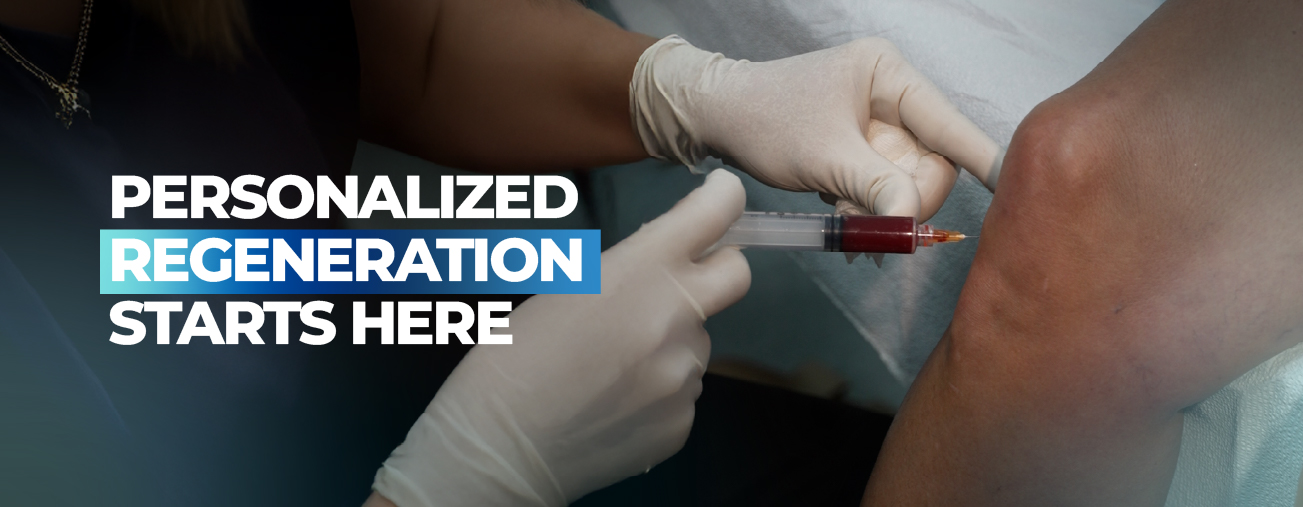
PRP (Platelet-Rich Plasma) concentrates the platelets from your own blood and delivers their growth factors directly into damaged tissue. It amplifies a healing process your body already runs, just at much higher concentration than normal circulation provides.
Exosomes are not cells at all — they’re the signaling vesicles cells use to communicate. Exosome therapy delivers concentrated signaling molecules that direct existing tissue to repair more efficiently, without introducing any living cells into the body. Read more in our article on what exosomes actually are.
Stem cells are living cells capable of differentiating into the type of tissue needed at the injury site — cartilage, tendon, or disc tissue — while also releasing their own growth factors and signaling molecules. They offer the most biologically active option of the three, with the ability to contribute new tissue directly rather than only signaling repair.
The simplest way to think about the hierarchy: PRP amplifies existing repair signals, exosomes deliver concentrated cellular communication without any cells, and stem cells add the potential for actual new tissue formation on top of both.
When PRP Is the Right Fit
PRP is usually the first option for tendon and ligament conditions where some healthy tissue remains — tendinopathy, partial tears, mild-to-moderate joint arthritis, and acute sports injuries. It’s the most studied and most widely available of the three, with the strongest clinical evidence base for conditions like rotator cuff tendinopathy and disc-related back pain.
Choose PRP when the damage is moderate, the tissue still has repair capacity, and you want the most established, lower-cost regenerative option as a first step before considering anything more advanced.
When Exosomes Are the Right Fit
Exosomes make the most sense when you want a non-cellular option — no risk of rejection, no concern about cell growth — particularly for hair restoration, skin rejuvenation, and as a signaling boost alongside other treatments. They’re also useful for patients who aren’t candidates for cell-based therapy but still want to support tissue repair through enhanced cellular communication.
Exosomes are not typically the standalone answer for significant structural damage — cartilage loss, complete tears, advanced degeneration. Their strength is signaling and communication, not replacing tissue that’s already gone.
When Stem Cells Are the Right Fit
Stem cells make sense when the damage is more advanced and PRP alone hasn’t produced enough improvement, or when imaging shows significant cartilage loss, moderate-to-severe disc degeneration, or larger tissue defects that need more than a signaling boost. Stem cell therapy for knees and stem cell therapy for back pain both work through this deeper mechanism — differentiation into tissue-specific cells plus a stronger signaling effect than PRP or exosomes alone.
Choose stem cells when the structural damage is significant enough that you need the most biologically active option available, or when you’re trying to avoid surgery for a condition that’s more advanced than mild-to-moderate.
A Quick Comparison
Mechanism: PRP amplifies your body’s existing growth factor signal. Exosomes deliver concentrated cellular messaging without living cells. Stem cells differentiate into needed tissue types while also signaling repair.
Best for mild-to-moderate damage: PRP is typically the first choice — most established evidence, lowest cost, fastest to administer.
Best for non-cellular preference or aesthetic applications: Exosomes — no rejection risk, strong fit for hair and skin applications.
Best for advanced structural damage: Stem cells — the deepest biological intervention, most appropriate when PRP alone is unlikely to be sufficient.
Cost: PRP is generally least expensive ($500–$2,500 per session), exosomes vary widely by application, and stem cell therapy tends to be the most expensive ($2,500–$10,000 per treatment) given the complexity of harvest and processing.
Can You Combine Them?
Yes, and for moderate-to-complex cases, combining treatments often produces better outcomes than relying on one alone. A common approach: stem cells address structural repair, while PRP or exosomes amplify the surrounding signaling environment to support faster, more complete healing. The right combination — if any — depends entirely on your specific diagnosis, not a default package.
This is also why a thorough evaluation matters more than picking a treatment off a menu. We cover the broader question of candidacy in our article on who is a candidate for regenerative therapy.
Finding the Right Fit in Orlando
At Regenerative Sport, Spine & Spa, located at 10920 Moss Park Rd Suite 218, Orlando, FL 32832, Dr. Manuel Colón and Dr. Dana Kleinman evaluate your imaging, history, and treatment goals before recommending PRP, exosomes, stem cells, or a combination. We don’t default to the most expensive option, and we don’t default to the cheapest one either — we recommend what your specific condition actually needs.
Contact our team at 888-557-5682 to schedule a consultation and get a direct answer on which regenerative therapy fits your condition.
Frequently Asked Questions
What is the difference between PRP, exosomes, and stem cells?
PRP concentrates your own platelets to deliver growth factors that amplify existing healing. Exosomes are non-cellular signaling vesicles that direct tissue repair through concentrated cellular communication. Stem cells are living cells that can differentiate into needed tissue types while also releasing their own repair signals. PRP amplifies an existing process, exosomes deliver pure signaling without cells, and stem cells add the potential for actual new tissue formation.
Which is better, PRP or stem cells?
Neither is universally better — it depends on the severity of your condition. PRP is typically the right first step for mild-to-moderate tendon, ligament, or joint damage where healthy tissue remains. Stem cells are more appropriate for advanced structural damage, significant cartilage loss, or cases where PRP alone hasn’t produced sufficient improvement. Many patients start with PRP and add stem cells if needed, rather than choosing one exclusively from the start.
Are exosomes better than stem cells?
They serve different purposes rather than one being categorically better. Exosomes carry no risk of rejection since they’re not living cells, making them appealing for patients who prefer a non-cellular option or for aesthetic applications like hair and skin. Stem cells offer the ability to differentiate into needed tissue types, making them more appropriate for significant structural damage that exosome signaling alone is unlikely to resolve.
Can PRP, exosomes, and stem cells be combined?
Yes. For moderate-to-complex conditions, combining treatments often produces better outcomes than relying on one alone — a common approach uses stem cells for structural repair while PRP or exosomes amplify the surrounding signaling environment. Whether combination treatment makes sense depends on your specific diagnosis and should come from a thorough clinical evaluation, not a default package.
How do I know which regenerative therapy is right for my condition?
The right choice depends on the severity of your condition, what current imaging shows, and your specific goals. Mild-to-moderate damage with intact tissue generally responds well to PRP first. Significant structural damage often calls for stem cell therapy. Aesthetic or signaling-focused goals may be well served by exosomes alone or in combination. A clinical evaluation with imaging review is the only accurate way to determine the right fit — not a generic recommendation applied to everyone.