Can disc herniation heal without surgery? For most patients, yes. Roughly 80 to 90 percent of herniated discs improve with conservative care within three to six months. That statistic surprises a lot of people who assume a herniated disc means an operating table. The real picture is more hopeful, and it’s also more nuanced than most online answers admit.
This article walks through how a herniated disc actually heals, what physical rehab should look like, how PRP and regenerative therapy accelerate the process, and when surgery genuinely becomes the right call.
What Happens Inside a Herniated Disc
Each spinal disc has a tough outer ring called the annulus fibrosus and a soft, gel-like center called the nucleus pulposus. A herniation happens when that gel center pushes through a tear in the outer ring. The displaced material can press on a nearby nerve root, and that pressure produces the classic symptoms: pain, numbness, tingling, and sometimes weakness in the area the nerve serves.
Here’s the part most people don’t know: your body has built-in mechanisms for dealing with that displaced material. Three processes work alone or together. Retraction pulls the herniated gel back toward its original position. Dehydration shrinks the displaced tissue as the body reabsorbs its water content. An immune response targets the out-of-place material and gradually breaks it down. Larger herniations that have fully extruded often trigger a stronger immune response than small contained bulges, which is one reason bigger herniations sometimes heal faster than smaller ones.
Can a Herniated Disc Heal on Its Own?
In many cases, yes. Around 60 percent of patients see significant symptom improvement within the first two months. By six months, roughly 80 to 90 percent report meaningful relief. These numbers come from multiple peer-reviewed sources and are consistent across the clinical literature.
But symptom relief and structural healing aren’t the same thing. Pain often resolves because the herniated material has shrunk enough to stop compressing the nerve — not necessarily because the disc has returned to its original shape. The disc may stay partially bulged without causing symptoms. This distinction matters: it explains why some patients feel fine for years and then experience a flare-up. The pain went away, but the underlying structural vulnerability didn’t.
Several factors influence how well and how fast a disc heals. Younger patients with good circulation typically recover faster. Smoking, obesity, and a sedentary lifestyle slow healing by reducing blood flow to spinal tissue. Lumbar herniations generally have a better natural prognosis than cervical ones. And patients who start structured conservative care early tend to do better than those who wait months before seeking evaluation.
Signs a Herniated Disc Is Healing
Recovery rarely feels like a straight line, but certain patterns tell you the healing process is on track:
- Pain becomes more localized. Radiating pain that pulls back toward the spine — instead of extending further down the leg or arm — is one of the clearest positive signs. This pattern even has a name: centralization.
- Numbness and tingling fade gradually. Nerve irritation calms down as pressure decreases, and sensation slowly returns to normal.
- You need less medication. A decreasing reliance on pain relievers or muscle relaxants reflects less inflammation around the nerve.
- Sleep improves. Less nerve irritation means fewer nighttime flare-ups and more restorative rest, which itself supports continued healing.
- Mobility increases. Bending, sitting, and walking become easier without triggering the same sharp pain.
Most people notice the first signs of improvement within four to six weeks of starting conservative treatment, with continued gains over the following months.
Herniated Disc and Sciatica
A herniated disc is the most common cause of sciatica — pain that radiates from the lower back through the buttock and down the leg. When a lumbar disc herniates and compresses the nerve roots that form the sciatic nerve, the result is the sharp, burning, or electric pain pattern many patients describe.
Not every herniated disc causes sciatica, and not every case of sciatica comes from a herniated disc — but when the two occur together, treating the disc directly is usually the most effective path to resolving the nerve pain. The same conservative and regenerative approaches discussed below apply to herniation-driven sciatica.
Physical Rehab: The Foundation of Recovery
Physical therapy is the backbone of conservative herniated disc treatment, and the research strongly supports it. A structured program typically progresses through phases.
Early Phase: Controlled Movement, Not Bed Rest
Short periods of rest — one to three days at most — can help during the most acute pain. Beyond that, extended bed rest works against you. It weakens supporting muscles and increases stiffness, which makes pain worse rather than better. Gentle movement keeps blood flowing to spinal tissue and helps reduce pressure on the affected nerve.
Mid Phase: Targeted Strengthening
Once acute pain settles, physical therapy shifts toward strengthening the muscles that support the spine — particularly the deep core stabilizers. Stronger support muscles reduce the load on the affected disc and lower the chance of re-injury. Posture correction is part of this phase too, since poor posture habits often contributed to the original herniation.
Later Phase: Functional Return
As strength and mobility improve, rehab progresses toward the movements and activities specific to your daily life or sport. This phase confirms the spine can handle real-world demands without flaring symptoms again.
How PRP Accelerates Disc Healing
Physical therapy supports the body’s natural healing mechanisms, but it doesn’t speed up tissue repair at the cellular level. That’s where PRP therapy adds something physical therapy alone can’t provide.
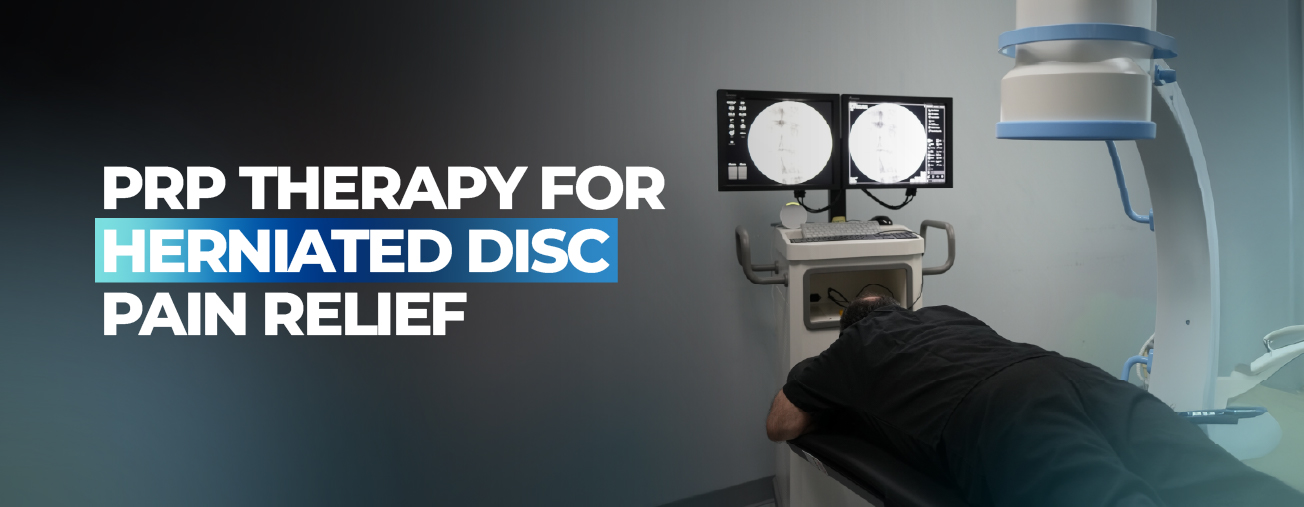
Intervertebral discs have almost no blood supply, which is exactly why they heal slowly compared to other tissue in the body. PRP delivers concentrated growth factors directly into the disc space, supplying the repair signal that circulation can’t deliver on its own. Clinical trials on intradiscal PRP have reported strong results: one 48-week study found 71 percent of patients with discogenic low back pain classified as treatment successes, with measurable improvements in both pain and disc hydration on imaging.
For herniations that haven’t responded adequately to physical therapy alone after six to eight weeks, PRP is a meaningful next step before considering surgery. It doesn’t replace rehab — it works alongside it, accelerating the biological repair while physical therapy rebuilds strength and mechanics around the healing disc.
Stem Cell Therapy for More Advanced Cases
For herniations involving more significant disc degeneration, stem cell therapy goes a step further. Stem cells introduced into the disc space can differentiate into disc-like cells and release growth factors that support structural repair — not just symptom relief. Studies have documented partial restoration of disc height in patients with mild-to-moderate degeneration treated with intradiscal stem cell injections, which is something neither physical therapy nor PRP alone typically achieves.
When Does a Herniated Disc Need Surgery?
Surgery is typically reserved for cases where conservative and regenerative treatment hasn’t produced meaningful improvement, or where specific red-flag symptoms appear. Seek evaluation promptly if you experience:
- Severe pain that hasn’t improved after six weeks of structured conservative care
- Progressive weakness in the arm or leg, rather than stable or improving strength
- Pain that keeps worsening instead of stabilizing or improving over time
- Loss of bladder or bowel control — this requires emergency evaluation, not a scheduled appointment
For everyone else, the research is clear: most patients improve substantially without ever needing an operation, particularly when conservative care starts early and regenerative options are added when progress stalls.
Herniated Disc Treatment in Orlando
At Regenerative Sport, Spine & Spa, located at 10920 Moss Park Rd Suite 218, Orlando, FL 32832, every herniated disc evaluation starts with current imaging and a thorough clinical assessment. Dr. Manuel Colón and Dr. Dana Kleinman build a treatment plan around your specific herniation — its size, location, and how your symptoms have progressed — rather than a one-size-fits-all protocol.
If you’ve been managing a herniated disc with rest and over-the-counter medication but haven’t seen the improvement you expected, contact our team at 888-557-5682 to schedule a consultation. Bring any imaging you have.
You can also read more about degenerative disc disease and whether it can be reversed, sciatica causes and regenerative treatment options, and PRP therapy for back pain.
Frequently Asked Questions
Can a herniated disc heal on its own?
Yes, in most cases. Roughly 60 percent of patients see significant improvement within the first two months, and 80 to 90 percent improve within three to six months using conservative care like rest, physical therapy, and anti-inflammatory medication. The body has natural mechanisms — retraction, dehydration, and an immune response — that work to shrink and reabsorb displaced disc material. Symptom relief doesn’t always mean the disc has fully returned to its original shape, but for most patients, pain resolves enough to return to normal activity.
How long does it take for a herniated disc to heal?
Most people notice meaningful symptom improvement within four to six weeks of starting conservative treatment. By two months, around 60 percent of patients report significant relief. By six months, that number climbs to 80 to 90 percent. Full structural healing of the disc itself — as opposed to symptom relief — typically takes six to twelve months. Larger herniations sometimes heal faster than smaller ones because they trigger a stronger immune response that breaks down the displaced material more efficiently.
What are the signs a herniated disc is healing?
Key signs include pain that becomes more localized and pulls back toward the spine rather than radiating further down the limb, gradually fading numbness and tingling, decreasing reliance on pain medication, improved sleep quality, and increasing ease of movement during daily activities. These improvements usually appear gradually rather than all at once, and most patients notice the first positive changes within four to six weeks of consistent conservative care.
Does PRP or stem cell therapy help a herniated disc?
Yes, particularly for cases that haven’t responded fully to physical therapy alone. PRP delivers concentrated growth factors directly into the disc space, supplying a repair signal that the disc’s poor blood supply can’t generate on its own. Clinical trials on intradiscal PRP report treatment success rates around 71 percent at 48 weeks. Stem cell therapy goes further for more advanced degeneration, with documented partial restoration of disc height in some patients. Both work alongside physical therapy rather than replacing it.
When does a herniated disc need surgery?
Surgery becomes appropriate when severe pain hasn’t improved after six weeks of structured conservative care, when weakness in the arm or leg is progressive rather than stable, when pain keeps worsening instead of stabilizing, or when there’s any loss of bladder or bowel control — the last of which is a medical emergency requiring immediate evaluation, not a scheduled visit. For the large majority of patients without these red-flag symptoms, conservative and regenerative treatment resolves the herniation without ever requiring an operation.