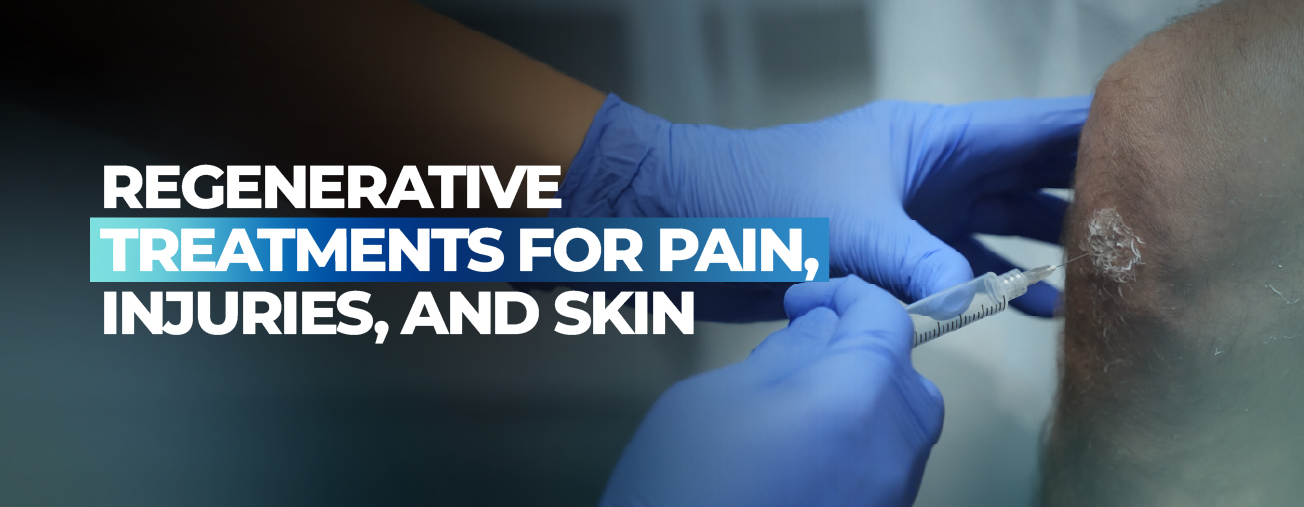
Conditions treated with PRP and stem cell injections span a wider range than most people expect. These treatments started in orthopedics and sports medicine, but the applications now extend into spine care, hair restoration, and sexual wellness. This guide organizes the full picture by category, so you can see at a glance whether your specific condition is one that regenerative medicine is positioned to help.
Joint Conditions
Arthritis in the knee, shoulder, hip, and ankle is one of the most common reasons patients seek regenerative treatment. PRP reduces joint inflammation and supports cartilage cell function in mild-to-moderate cases. Stem cells go further for more advanced cartilage loss, with the potential to support structural repair that PRP alone can’t achieve. Our detailed guide to stem cell therapy for knees covers this in depth, including the honest comparison to knee replacement surgery.
Meniscus tears, particularly partial and degenerative tears common in active adults, also respond to both treatments — reducing inflammation around the tear and supporting the surrounding tissue environment.
Spine Conditions
Spinal disc and joint conditions make up a significant portion of what we treat. Degenerative disc disease and herniated discs respond to intradiscal PRP and stem cell injections, with documented improvements in both pain and disc structure in clinical trials. Facet joint arthropathy and sacroiliac joint dysfunction — two frequently underdiagnosed causes of chronic back and neck pain — also respond well to targeted injections.
Sciatica, whether from a herniated disc, spinal stenosis, or piriformis syndrome, is treated by targeting whichever structure is compressing the nerve. Post-surgical back pain — pain that persists after spine surgery didn’t fully resolve symptoms — is another well-established application.
Tendon and Ligament Injuries
This is where PRP has its strongest, most studied evidence base. Rotator cuff tendinopathy and partial tears, tennis and golfer’s elbow, Achilles tendinopathy, patellar tendinopathy, and plantar fasciitis all show consistent benefit from PRP injections, frequently outperforming cortisone in long-term outcome studies. Our guide to muscle tears and tendon injuries covers each of these in detail.
Partial ligament tears — including MCL injuries and select partial ACL tears — respond to PRP and stem cell injections as part of a non-surgical recovery plan, when the anatomy and severity make conservative management realistic.
Sports Injuries
Athletes use both treatments to recover faster from acute and chronic injuries. PRP helps reduce return-to-play timelines for hamstring strains, ankle sprains, and overuse injuries by accelerating tissue repair beyond what rest alone provides. Runner’s knee and other patellofemoral conditions also respond well, particularly when combined with appropriate strengthening work. See our overview of the five most common sports injuries for a breakdown by injury type.
Nerve and Neuropathy Conditions
Peripheral neuropathy that hasn’t responded well to medication is an area of growing application for PRP and stem cell injections. Both can reduce neuroinflammation and support nerve tissue health, though nerve healing tends to be slower than tendon or joint repair, requiring patience and realistic timeline expectations.
Hair Loss
PRP for hair restoration is one of the most accessible and well-tolerated regenerative applications, working by stimulating dormant hair follicles with concentrated growth factors. Exosome therapy for hair loss offers a non-cellular alternative that works through similar follicle-activation signaling.
Sexual Wellness
PRP injections are used for erectile dysfunction, working by improving blood vessel formation and tissue health in the treated area. This application has grown significantly as more clinical data accumulates on outcomes for men who haven’t responded fully to standard medication.
What Determines Whether You’re a Good Candidate
Across every category above, the same principle applies: regenerative therapy works best when there’s still viable tissue for the treatment to act on. Mild-to-moderate damage responds more predictably than end-stage degeneration. Patients who’ve tried conservative treatment without lasting relief, or who want to avoid surgery, are typically the strongest candidates. We cover the full criteria in our article on who qualifies for regenerative therapy.
Choosing between PRP and stem cells specifically depends on severity and tissue condition — a question we break down fully in PRP vs exosomes vs stem cells.
Getting Evaluated in Orlando
At Regenerative Sport, Spine & Spa, located at 10920 Moss Park Rd Suite 218, Orlando, FL 32832, Dr. Manuel Colón and Dr. Dana Kleinman evaluate every condition individually with current imaging and a full clinical history. If your condition isn’t listed above, it’s still worth asking — regenerative medicine’s range of application continues to expand, and a direct evaluation is the only accurate way to know if it applies to you.
Contact our team at 888-557-5682 to schedule a consultation.
Frequently Asked Questions
What conditions does PRP treat?
PRP treats tendon and ligament injuries like tennis elbow, rotator cuff tendinopathy, and Achilles tendinopathy; joint conditions including arthritis and partial meniscus tears; spinal conditions like degenerative disc disease and facet joint pain; sciatica; sports injuries including hamstring strains and ankle sprains; hair loss; and erectile dysfunction. PRP works best when there’s still viable tissue for its growth factors to act on, making it most effective for mild-to-moderate damage rather than severe structural loss.
What conditions does stem cell therapy treat?
Stem cell therapy treats many of the same conditions as PRP but is typically reserved for more advanced cases — moderate-to-severe joint arthritis, significant disc degeneration, larger cartilage defects, and chronic conditions that haven’t responded sufficiently to PRP alone. Because stem cells can differentiate into needed tissue types in addition to releasing growth factors, they offer a deeper biological intervention for structural damage.
Can PRP and stem cells treat the same condition?
Yes, often. Many conditions — knee arthritis, back pain, tendon injuries — can respond to either treatment depending on severity. Mild-to-moderate cases often start with PRP given its lower cost and strong evidence base. More advanced cases, or those that haven’t improved sufficiently with PRP, frequently move to stem cell therapy. The two are also sometimes combined in the same treatment plan for complex cases.
Is my condition treatable with regenerative medicine?
If your condition involves a tendon, ligament, joint, spinal disc, nerve, hair follicle, or vascular tissue with some degree of remaining function, it’s worth a clinical evaluation. Conditions with extensive structural loss — complete tendon ruptures, end-stage arthritis with no remaining cartilage — are less likely to benefit from regenerative treatment alone and may need surgery first. An evaluation with current imaging is the only accurate way to determine whether your specific condition is a good fit.