If you’ve been searching for shockwave therapy near you, chances are you’ve already exhausted a few other options. Shockwave therapy tends to appeal to patients who have tried physical therapy, cortisone shots, or rest — and are still dealing with the same pain months later. That’s not a coincidence. It’s exactly the type of chronic, treatment-resistant pain shockwave is designed for.
This article covers what shockwave therapy actually does at the tissue level, which conditions it treats most effectively, and what the procedure feels like — so you can decide whether it’s worth pursuing for your specific situation.
How Shockwave Therapy Works
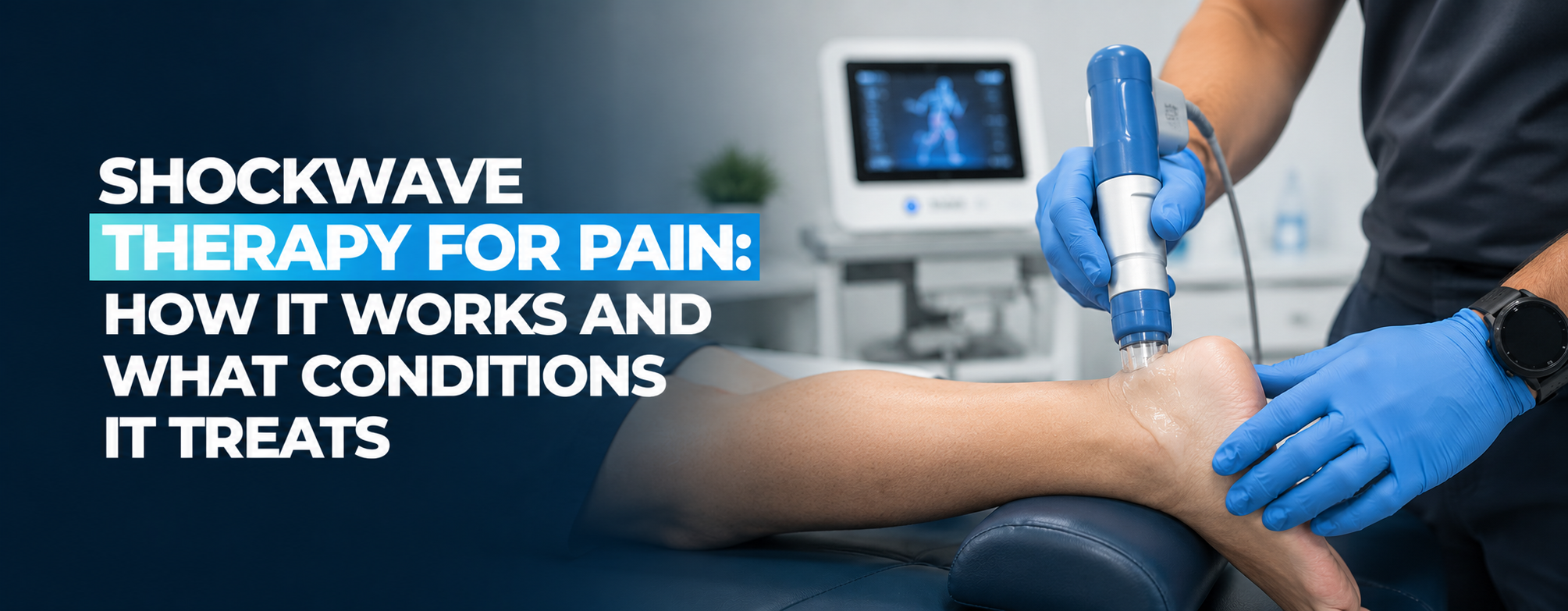
Shockwave therapy uses high-energy acoustic waves — delivered through a handheld device pressed against the skin — to penetrate deep into soft tissue, tendons, and joints. No needles, no incisions, no surgery. The waves create a controlled mechanical stimulus that triggers a cascade of biological responses in the treated area.
Three things happen when shockwave energy reaches damaged tissue. First, it breaks up calcifications — calcium deposits that form in tendons and soft tissue as a result of chronic injury — which are often a hidden source of ongoing pain. Second, it increases local blood flow and stimulates the formation of new blood vessels (neovascularization), bringing oxygen and repair cells to areas that have been poorly perfused. Third, it activates the body’s own healing response by triggering growth factor release and stimulating collagen production.
This is why shockwave works particularly well on conditions that haven’t responded to conventional treatment: it restarts a healing process that has stalled. Tendons and ligaments with poor blood supply don’t heal on their own easily — shockwave forces the biological environment to change.
Conditions Shockwave Therapy Treats
Plantar Fasciitis and Heel Pain
Plantar fasciitis is one of the most well-studied applications for shockwave therapy. When the fibrous band connecting the heel to the toes becomes inflamed and calcified, standard stretching and orthotics often provide only partial relief. Shockwave therapy breaks up the calcifications, reduces the chronic inflammation, and stimulates repair in the plantar fascia itself. Most patients need three to five sessions and see significant improvement within four to eight weeks.
Tennis Elbow and Golfer’s Elbow
Lateral epicondylitis (tennis elbow) and medial epicondylitis (golfer’s elbow) are both tendon degeneration conditions, not simple inflammation. They persist because the tendon tissue has partially broken down and isn’t repairing effectively. Shockwave therapy has some of the strongest clinical evidence in the field for these conditions, with multiple trials showing it outperforms cortisone injections for long-term outcomes. Cortisone provides faster initial relief but often allows the tendon to continue degenerating. Shockwave treats the degeneration directly.
Shoulder Pain and Calcific Tendinitis
Shoulder pain from rotator cuff tendinopathy and calcific tendinitis responds consistently well to shockwave. Calcific deposits in the rotator cuff are a direct target for shockwave’s calcium-breaking mechanism. Frozen shoulder (adhesive capsulitis) is also treatable, particularly in the earlier inflammatory stages.
Back and Neck Pain
Shockwave therapy for back and neck pain works best on myofascial pain — chronic muscle tension and trigger points that develop in the muscles surrounding the spine. When combined with other regenerative approaches like PRP therapy or prolozone for structural issues, shockwave addresses the muscular component that often persists even after joint or disc treatment.
Knee Pain and Patellar Tendinopathy
Patellar tendinopathy — often called “jumper’s knee” — is a chronic tendon condition that plagues athletes and active adults. Knee pain from tendinopathy responds well to shockwave because, like other tendon conditions, the underlying issue is degenerative rather than purely inflammatory. Shockwave stimulates collagen remodeling in the tendon and can reduce pain significantly within a few treatment cycles.
Arthritis Pain
Shockwave therapy for arthritis reduces the inflammatory burden in affected joints and can improve mobility, though it doesn’t reverse structural cartilage loss. For patients with mild to moderate arthritis who aren’t candidates for injection-based therapies, or as a complement to stem cell treatments, shockwave is a useful non-invasive addition to the treatment plan.
Neuropathy and Nerve Pain
Shockwave therapy for neuropathy is an emerging application with growing evidence. The acoustic waves can improve microcirculation in the affected nerves and reduce the hypersensitivity that drives neuropathic pain. For patients with peripheral neuropathy who haven’t responded well to medication, shockwave offers a non-pharmacological option worth evaluating.
What a Shockwave Therapy Session Feels Like
The device is applied directly to the skin over the treatment area, usually with a coupling gel similar to what’s used in ultrasound. You’ll feel a series of rapid pulsing sensations — some patients describe it as a flicking or tapping, others as a deep pressure with brief sharp points over the most damaged areas.
Is shockwave therapy painful? The honest answer is: it’s uncomfortable in a tolerable way for most patients. The most sensitive areas — where calcifications are present or inflammation is concentrated — can produce sharper sensations. The intensity is adjustable, and your provider should work within your comfort threshold. The discomfort typically subsides within seconds of the device moving to a different area.
Sessions last 15 to 25 minutes depending on the treatment area and number of sites. Most protocols involve three to six sessions spaced one week apart. You can return to light activity the same day. Avoid high-impact activity for 48 hours after each session, as the tissue needs time to begin the repair process the shockwave initiated.
How Many Sessions Are Needed and When to Expect Results
Three sessions is the typical starting point for most tendon and soft tissue conditions. Plantar fasciitis often resolves or significantly improves within three to five sessions. More complex conditions — calcific tendinitis with large deposits, chronic tendinopathy that has been present for years, or neuropathy — may require five to eight sessions for full benefit.
Results build over time rather than appearing immediately. The biological changes shockwave triggers — neovascularization, collagen production, calcium resorption — take weeks to fully develop. Most patients notice meaningful improvement within three to six weeks of starting treatment, with continued progress over the following two to three months.
One counterintuitive pattern worth knowing: some patients feel worse for 24 to 48 hours after the first one or two sessions. This is a normal inflammatory response — the shockwave has activated a healing process that involves temporary increased inflammation before improvement sets in. It’s not a sign the treatment isn’t working.
Shockwave Therapy in Orlando
At Regenerative Sport, Spine & Spa in Lake Nona, Orlando, we offer shockwave therapy as a standalone treatment and as part of integrated regenerative protocols. For many patients, it’s the first non-invasive step we recommend — before injections, and well before surgery.
Dr. Dana Kleinman and Dr. Manuel Colón evaluate each patient individually to determine whether shockwave is appropriate, whether it should be combined with other treatments like PRP or prolozone, and what a realistic protocol looks like for your specific condition.
Contact our team to schedule a consultation. You can also learn how shockwave fits alongside other regenerative options by reading about PRP for back pain, natural recovery from sports injuries, or the full range of treatments we offer.
Frequently Asked Questions
Does shockwave therapy work?
Yes, for specific conditions. The strongest clinical evidence supports shockwave for plantar fasciitis, lateral epicondylitis (tennis elbow), calcific shoulder tendinitis, and patellar tendinopathy. Multiple randomized controlled trials show it outperforms sham treatment and produces outcomes comparable to or better than cortisone injections for long-term pain relief. Results are weaker for acute injuries — shockwave is most effective when pain has been present for at least four to six weeks and hasn’t responded to conservative treatment.
How much does shockwave therapy cost?
Shockwave therapy typically costs between $100 and $500 per session depending on the provider, the treatment area, and the number of sites treated. A full protocol of three to six sessions ranges from roughly $300 to $2,500 in total. Most insurance plans don’t cover shockwave therapy for musculoskeletal conditions, though some do for specific diagnoses like plantar fasciitis. HSA and FSA funds can often be applied.
Is shockwave therapy painful?
It’s uncomfortable rather than painful for most patients. The sensation over healthy tissue feels like a rapid tapping or deep pressure. Over inflamed or calcified areas, some sharp sensations are normal and tend to be brief. Intensity is adjustable — your provider should work within a threshold you can tolerate. Most patients rate the discomfort as manageable, and it stops immediately when the device is removed.
What are the side effects of shockwave therapy?
The most common side effects are temporary soreness, mild bruising, or redness at the treatment site for one to two days after a session. Some patients experience a temporary worsening of pain in the first 24 to 48 hours — this is a normal part of the healing response the shockwave triggers, not a sign of damage. Serious complications are rare. Shockwave is not appropriate over open wounds, active infection sites, near implanted hardware, or during pregnancy.
How many sessions of shockwave therapy do I need?
Most protocols start with three sessions spaced one week apart. Straightforward conditions like plantar fasciitis often show significant improvement within three to five sessions. More chronic or complex conditions — large calcific deposits, long-standing tendinopathy, or neuropathy — may need five to eight sessions. Your response to early sessions guides the total number. A provider who locks you into a large package before evaluating your response after the first few sessions is a red flag.
Is shockwave therapy covered by insurance?
Coverage varies significantly by insurer and diagnosis. Some plans cover shockwave for plantar fasciitis and specific tendinopathies when conservative treatments have failed and documentation requirements are met. Most plans classify it as experimental for other conditions. HSA and FSA accounts typically cover it as a qualified medical expense. Always verify with your insurance before your first session rather than assuming coverage either way.